
Letby case briefing paper
Updated: Sep 11
I was asked to write a briefing paper for someone in a position of influence. The person who asked me suggest I make it public. Here it is.
Briefing document for REDACTED about the Lucy Letby case
Peter Elston MA BSc FGS, pjelston@me.com, 07475XXXXXX
Introduction
Only the Courts can decide whether a conviction is unsafe. This paper seeks to set out the various arguments regarding the safety of the convictions of Countess of Chester Hospital (CoCH) neonatal nurse Lucy Letby’ that have been or might still be put to the Criminal Cases Review Commission.
To appraise these arguments, some knowledge of the case is required.
Summary of the case
During the four years from 2011 to 2014, ‘in house’ deaths on CoCH’s neonatal unit (NNU) and transfer deaths (those following transfer from CoCH’s NNU to higher level units) averaged, respectively, 2.5 and 1 per year[1].
During the 13 months from June 2015 to June 2016 incl. there were 13 ‘in house’ and 3 transfer deaths, around 5- and 3-times historical averages, respectively. In other words, they represented a statistically significant spike in deaths.
In November 2020, neonatal nurse Lucy Letby was charged with eight murders and ten attempted murders. At the trial, which began in October 2022, she was charged with seven murders and 15 attempted murders. There was no direct evidence against her. Nobody had seen her harm a baby. The strongest evidence against her were two blood test results that, since the trial, have been shown to have viable alternative explanations.
In August 2023 she was found guilty on all seven murder charges. With respect to the 15 attempted murder charges, she was found guilty on seven of the counts, not guilty on two, and no verdict was reached on the other six.
The following June she was retried in relation to one of the ‘no verdicts’. She was found guilty, after jurors deliberated for just three hours.
Alternative explanation for the spike in mortality
The CoCH doctors’ explanation for the spike (later endorsed by the doctors engaged by the police as medical experts) was that babies were being intentionally harmed. And that it was Letby who was inflicting this harm.
There are, however, far more viable explanations for the spike. These are set out in this document but, in sum, they centre on the recorded spike in acuity and activity on CoCH’s NNU between June 2015 and June 2016 incl. Both higher acuity and activity would cause mortality risk to rise.
There are also more viable explanations in relation to specific cases. For example, the guidelines of the laboratory which obtained two unusual insulin test results (that became the closest thing the Crown had to forensic trace evidence) state that the unusual results obtained potentially had an endogenous aetiology.
It should also be noted that Letby was charged in relation to ‘only’ 7 of the 16 deaths (13 ‘in house’ and 3 transfer), leaving a second, statistically significant spike with which she was not associated.
Violent crime
According to the Crown Prosecution Service, “Violent crime covers a variety of offences – ranging from common assault to murder. It also encompasses the use of weapons such as firearms, knives and corrosive substances like acid”.[2]
However, unlike cases where the evidence of crime is immediately obvious (e.g. knife wounds, gunshot wounds, etc) the evidence of crime in medical cases (e.g. suspected intentional harm by a healthcare professional or suspected child abuse) is often unclear.
Where evidence of crime is obvious, the investigation need only focus on identifying the perpetrator or perpetrators.
In medical cases where evidence of crime is obscure or unclear, investigations should focus first on determining whether a crime or crimes had been committed, then on identifying the perpetrator or perpetrators. Where proper investigative protocols are not employed, these two processes can become muddled, contaminated. This is what happened in the Letby case.
The elevated mortality at CoCH in 2015 and 2016
In June 2015, in the space of just 14 days, three babies (A, C, and D) died on CoCH’s NNU. In the context of an historical average number of deaths of 2.5 per year, three deaths in 14 days were extremely high.
The two most senior paediatricians on the NNU, Drs Stephen Brearey and Ravi Jayaram, quickly pointed the finger at Band 5 neonatal nurse Lucy Letby. This was on the basis that, according to Dr Brearey, she was the only nurse on duty for all three deaths (this was not in fact true; there was one other nurse on duty for all three).
Rather than quickly pointing the finger at Lucy Letby, Drs Brearey and Jayaram should have considered other factors as, at least, contributing to the three deaths. These other factors are:
· There were pre- and post-admission issues with all three babies[3] (see Appendix 1)
· There had been closures of the main maternity unit in north Wales which meant babies who would have received Level 3 care instead ended up at the Level 2 unit at CoCH (there is also a nonlinear relationship between the distance mothers in labour must travel and mortality risk)[4]
· Another baby who was in the intensive care nursery throughout June 2015 had a serious infection (twice during the month he had to be transferred to a Level 3 unit where he recovered, was re-admitted to CoCH, then became unwell again, eventually being discharged in September 2015)[5]
The doctors eventually took their concerns about Letby to the medical director and the head of nursing in late 2015 and again in early 2016, by which time there had been more deaths. However, they were told that many of the babies who died had underlying health issues (all postmortems except one had cited cause of death as natural, the other citing ‘unascertained’). They were also told that the evidence of Letby having been on duty for many of the deaths was not strong, particularly since she was a qualified intensive care nurse and often did extra shifts.
Nevertheless, in April 2016, Drs Brearey and Jayaram persuaded the head of nursing to move Letby onto day shifts only, given that, according to them, the deaths to that point had occurred exclusively during night shifts. It should be noted that it was not in fact true that the deaths had occurred on night shifts only. Seven of them had occurred on night shifts and four on day shifts.
It is also not clear why the doctors did not follow GMC guidelines in relation to escalating concerns[6] (see Appendix 2).
Things came to a head in late June 2016 following the death of two monochorionic (single placenta) triplets.
As a result of these two deaths, three precautionary measures were taken:
1) Letby was moved to administrative duties,
2) CoCH’s NNU was downgraded to Level 1, and
3) CoCH commissioned a review by the Royal College of Paediatric and Child Health (RCPCH).
The downgrade to Level 1 meant that CoCH stopped admitting babies who required intensive care. Also, any high-risk babies born at CoCH had to be immediately transferred to higher level units.
July 2016 extraordinary board meeting
An extraordinary meeting of the board of directors of CoCH was held on 14 July, 2016. Drs Brearey and Jayaram attended this meeting. The minutes[7] note that, “There are strains in the system and as the neonatal lead, Mr Brearey could not see that any of the apparent changes in acuity, or staffing levels can account for the increased mortality”.
RCPCH service review
CoCH commissioned the RCPCH to conduct a service review of its NNU in July 2016. Interviews at the hospital were conducted on 1-2 September, and the report was published in November. In many respects, it was a litany of hospital failings (Appendix 4).
With respect to the recorded higher acuity and activity, the review noted the below.
3.7 Most of the consultants had been on duty for at least one of the deaths. Further in-depth analysis by the neonatal lead in July 2016 examined activity and acuity from June 2015. This included admissions per month, time between deaths, total care days per month, IT care days per month, birthweight and prematurity. This was not a systematic review but concluded that there was higher activity and lower admission birthweight than average during the period corresponding to the increase in mortality. This was not however considered to have been significant enough to explain the increase in mortality.
3.12: “In response to this allegation and the high acuity and activity on the unit the Medical Director, Nursing Director and Trust Board decided on 7th July to reduce the designation of the service to a Special Care Unit (SCU) caring for infants from a minimum of 32 weeks gestation pending an external review by the RCPCH, and the change appeared to have been handled sensitively and effectively by management with good network and public engagement.”
In light of it having been recorded in the minutes of the July Board meeting that, “Mr Brearey could not see that any of the apparent changes in acuity, or staffing levels can account for the increased mortality”, it seems likely that he was the source of the statement in the RCPCH review, “This [higher activity and lower admission birthweight than average] was not however considered to have been significant enough to explain the increase in mortality”.
The RCPCH review did however note that “In response to this allegation and the high acuity and activity on the unit the Medical Director, Nursing Director and Trust Board decided on 7th July to reduce the designation of the service to a Special Care Unit (SCU)”, suggesting that the acuity and activity may have had more of an impact on the elevated mortality than Dr Brearey suggested was the case.
Interestingly, the reference to “this allegation” was odd because to that point in the document there had been no reference to an allegation. It later transpired that the version which the hospital posted on its website in February 2017 (quickly taken down) had been redacted, and that the unredacted version mentioned the doctors’ allegation against Letby.
Nevertheless, the reference to “this allegation and the high acuity and activity” neatly set out the two competing explanations for the spike in mortality, essentially those of the paediatricians on the one hand and of the medical director and head of nursing on the other.
Letby files a grievance
After she was put on administrative duties, Letby filed a grievance against the doctors who had pointed the finger at her, which, in January 2017, she won.
Despite Letby’s grievance being upheld, the hospital was persuaded by the doctors to go the police, which they did in April 2017 via the Child Death Overview Panel (CDOP).
Mortality, Acuity and Staffing 2015 – 2016
Dr. Brearey and his clinical colleagues compiled the document Mortality, Acuity and Staffing 2015 – 2016 in early 2017[8]. It was drafted in response to hospital executives (specifically Ian Harvey) raising questions about the unit's acuity and activity and was designed to reassure police and management that staffing levels and baby acuity were not responsible for the elevated death rates.
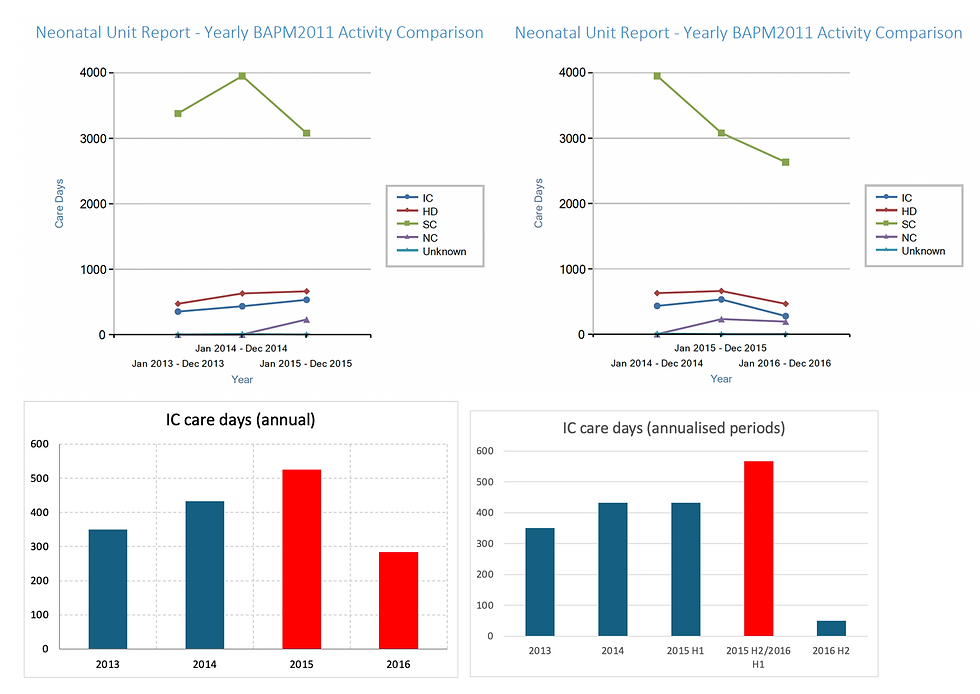
It contained several tables and graphs. Two of them (below) presented the number of care days for various types of care for 2013, 2014 and 2015 and for 2015, 2015 and 2016. This was a somewhat peculiar way to present the data, given that the four years could have been presented in one chart rather than two.
In relation to the two charts, the document noted, “High dependency and intensive care days did not change appreciably in 2015 and 2016 compared to previous years.” This is disingenuous. The spike occurred in the 13 months from June 2015 to June 2016, not in the 24 months of 2015 and 2016.
Assuming a) the annualised number of care days in the first half of 2015 was the same as in 2014, and b) there was a very sharp drop in IC care days in the second half of 2016 which would have occurred as a result of the unit’s downgrade to Level 1 in July 2016, there was in fact a c. 30% increase in annualised IC care days in H2 2015/H1 2016 compared with 2014/H1 2015 (lower right chart below, with data from the upper two charts put into the lower left chart for comparison). For comparison purposes, the lower left chart below combines the four years from the upper two charts and is of Intensive Care Days only.
This brings into question the statement in the document, “…intensive care days did not change appreciably in 2015 and 2016 compared to previous years.”
This is important as the spike in acuity and activity represents a viable and more likely alternative to the inflicted harm hypothesis. It is also instructive that the document prepared by the doctors hid the increase in acuity and activity.
The early stages of the investigation by Cheshire Police
The evidence presented to Cheshire Police in early 2017 by CoCH doctors was not direct evidence of inflicted harm but indirect (circumstantial) evidence that a particular nurse, Letby, had been on duty when many of the deaths occurred.
Because the evidence presented to them by the doctors in early 2017 was weak, Cheshire Police were not at first convinced. The doctors regrouped and sought to find stronger evidence of inflicted harm, particularly evidence that pointed to Letby. They discussed this exercise by email[9], and the thread included the below from the paediatric clinical lead, Dr Jayaram (mistakes his).
Should we highlight explicitly for these cases that LL was in attendance and in close proximity to the incubators (in those situations we know for a fact she was)? This is after all the basis of our concerns and I think for the police to have their interest piqued we need to have that with all of the cases (it’s not going to be in the info Ian H/Stephen C have given to the police). I have attempted to do this as belwo for the ones I was involved with but hopefully more In a stating the facts way than a subjective finger pointing way.
In relation to one baby, Dr Jayaram also wrote the below by email.
At time of deterioration, nurse Williams off ward talking to parents on labour suite, Staff nurse Letby at incubator and called Dr Jayaram to inform of low saturations. Endotracheal tube had been secured properly and baby not over-active. No obvious reason for tube to have dislodged.
Dr Jayaram's comment, "Staff nurse Letby at incubator and called Dr Jayaram to inform of low saturations" is interesting because at trial, under oath, he testified that Letby had not called him into nursery 1 and the reason he went into nursery 1 was that he suddenly got an uneasy feeling. He also said alarms had not sounded whereas nurse Joanne Williams testified that they did. And there is a question was to whether it was in fact Letby in nursery 1 at Baby K's cot. It would have made far more sense for it to have been Caroline Oakley given that she was looking after the other baby in nursery 1 (Letby was looking after two babies in nursery 2).
The CoCH doctors put together and submitted to Cheshire Police on 10 May 2017 a document titled Reasons for concerns regarding a possible criminal cause for increased neonatal mortality at the Countess of Chester Hospital NHS Foundation Trust, June 2015 – July 2016[10]. In relation to the baby to which Dr Jayaram referred in his email, the document said:
25 week gestation infant. Ventilated. Sudden deterioration at 0350 with misplaced ETT. Consultant could not explain how the ETT became misplaced. Transferred and died in APH. Nurse L present on unit.
The police then met with Drs Brearey, Jayaram (as well as fellow CoCH paediatrician Susie Holt) on 15 May 2017[11]. In relation to the baby mentioned by Dr Jayaram in the above-mentioned email and document, the minutes record him as saying:
RJ - the staffing review has looked at the notes, this has not necessarily been picked up. What has not been looked at, this baby collapsed, who was where, what were you doing at the time. As consultants, it is very rare that consultants were present at time of collapse. At the point of the collapse, the nurse was present at that time in close proximity. This has not happened to other staff.
I can speak about one that did collapse, but survived, 27 weeks, was stable had breathing tube down, good ventilation, named nurse (ie nurse assigned to care for baby during that particular shift) had gone out of nursery. I went back in, the baby's oxygen levels had dropped, first thing to do disconnect baby from ventilator and bag. I noticed the breathing tube had been dislodged. The nurse (L) was present at the time.
It seems clear that Jayaram’s insinuations in relation to this baby evolved quickly.
The doctors suspected inflicted harm because they said that, prior to collapse, the babies had been well and stable, and thus that the collapses were unexpected and unexplained. The new defence experts have said that this was not the case.
The minutes of the meeting also note the below statement by Dr Jayaram.
RJ - did some reading and found that situation called air embolism, small amounts of free air in circulation can obstruct flow of blood into the lungs, free oxygen can be picked up. There is a rash associated with these diagnosis
The ‘reading’ to which Dr Jayaram referred was of a 1989 paper titled Pulmonary vascular air embolism in the newborn. The paper described a skin discolouration (not a ‘rash’, which is superficial i.e. not related to blood supply) associated with air embolus as below.
Blanching and migrating areas of cutaneous pallor were noted in several cases and, in one of our own cases we noted bright pink vessels against a generally cyanosed cutaneous background.
In his later witness statements, Dr Jayaram wrote, with respect to one baby:
He had unusual discoloration; you’d expect babies to look fairly ghastly and pale and grey but he had an odd sort of discoloration where there were flitting patches of pink areas on the background of bluey grey skin; these patches seemed to appear and disappear. It wasn’t like the rash seen with a meningococcal sepsis which is caused by blood vessels bursting. It would flit and the reappear and disappear. It didn’t fit with anything I’d ever seen before.
This description is remarkably similar to that in the 1989 paper. And yet, Dr Jayaram had not mentioned this “unusual discolouration” in the contemporaneous medical notes, nor in his report to the coroner in relation to Baby A a month or so later. Nobody had.
The doctors have been criticised for not escalating their concerns about Letby to their governing body, the GMC nor, perhaps more appropriately, given that they believed a nurse was murdering babies, to the police.
Dr Jayaram is also noted in the minutes of the meeting to have said:
RJ — if you have concerns about Dr you would report to GMC; concerns about a Nurse to Nurse and midwifery council, if wider issue like this, escalate through the trust. Regarded as whistleblowing if you go outside. We have taken advice from our medical defence unions to do everything within the trust and deal that route
Dr Jayaram was wrong when he said that concerns about a doctor would be reported to the GMC and about a nurse to the NMC. A doctor’s concerns about a nurse would be reported to both the GMC and the NMC. (See Duty to raise concerns in Appendix 2, which notes, “All doctors have a duty to raise concerns where they believe that patient safety or care is being compromised by the practice of colleagues…”)
Also, it is far from clear from Dr Jayaram’s statement precisely when the doctors took advice from their medical defence unions. Unless it was around the time they approached the head of nursing and the medical director (late 2015/early 2016), their excuses for not going to the police if they suspected a nurse was intentionally harming babies do not seem credible.
Nevertheless, because of the doctors’ document and the meeting with Drs Brearey, Jayaram, and Holt, Cheshire Police, on 18 May 2017, announced to the public that it had launched an investigation into baby deaths[12], soon to become known as Operation Hummingbird.
Dr Dewi Evans and other recommendations by the NCA to Cheshire Police
Around the time that Operation Hummingbird was launched by Cheshire Police in May 2017, Dr Dewi Evans, a long-retired paediatrician now working as a medico-legal expert predominantly in the family court system, sent an email to his contact at the National Crime Agency (NCA) offering his services in relation to the investigation into baby deaths in Cheshire that he had read about in the paper (in his email he wrote, “Sounds like my kind of case”.)
The NCA recommended to Cheshire Police that they engage Dr Evans as a medical expert. It also advised Cheshire Police they should engage experts in other fields, as below.
· “Forensic and neonatal pathologists to review, jointly, the medical histories, etc.” Comment: Cheshire Police engaged just one pathologist, Dr Andreas Marnerides.
· “A forensic toxicologist and/or clinical pharmacologist to review the test results for all sampling conducted on all the babies, etc.” Comment: Cheshire Police instructed neither a forensic toxicologist nor a clinical pharmacologist.
· “A nurse with experience of working in a special baby unit for neonatal births, etc.” Comment: The nurse expert who was instructed was an adult nurse.
· “A medical expert with experience of the working practices involved in a special baby unit for neonatal births, etc.” Comment: none was instructed.
· “An obstetrician to review the medical histories, tests results, hospital notes/reports/scans, medication, etc.” Comment: no obstetrician was instructed.
Other suggestions by the NCA to Cheshire Police were also rejected.
It is also instructive that the NCA did not recommend to Cheshire Police that they engage an epidemiologist to investigate formally the cause of the elevated mortality. This omission suggests that neither the NCA nor Cheshire Police doubted the CoCH doctors’ belief that it was due to inflicted harm. This is extraordinary, given that the police could not assume the doctors did not have an ulterior motive for pointing the finger at Letby. Indeed, the police should have treated the doctors as suspects.
Cheshire Police did engage medical statistician Prof Jane Hutton in 2018. Not to consider all possible explanations for the elevated mortality but to calculate the probability of Letby being on duty for so many deaths. She told them they were approaching things the wrong way. In 2021, she was told her services were no longer needed.
Cheshire Police first met with Dr Evans on 10 July. He had asked to see the records of one or two of the babies to “give him an idea of what they were looking at”. He was shown the records of Baby O, which included photos showing injury to the baby’s liver. In his early witness statements, Dr Evans said that the injury had been caused by inflicted harm, evidence for which was a bruise on the skin over the baby’s liver. It was later discovered that the ‘bruise’ had disappeared quickly, so in Dr Evans’ later statements it became a fleeting discolouration that was evidence of injection of air into the bloodstream. He also continued to invoke a physical attack on the baby’s liver, but one that left no mark on the skin (at trial, prosecution expert pathologist Dr Andreas Marnerides, told the Court the severity of the injury was more consistent with that suffered in a road-traffic accident).
This is just one of many examples of Dr Evans’ changing and erratic opinions.
On 18 July 2017, Dr Evans wrote a letter to Cheshire Police about his thoughts following the 10 July meeting. In it, he wrote, “If there is an identifiable clinical cause it's unlikely that one would be able to distinguish this clinical event from a potentially suspicious one”.
Various external doctors (pathologists, neonatologists, etc) had by this point looked at the deaths during the period of elevated mortality and found only two cases where there was no identifiable clinical cause of collapse. Their findings were dismissed by the far less qualified Dr Evans, who determined quickly that there was no identifiable clinical cause in relation to many of the deaths (not all of which, notably, ended up on the indictment). And indeed, in relation to numerous non-fatal collapses (again, not all of which made it onto the indictment).
This is where the roster chart comes in, a chart shown to jurors, either as agreed evidence or as a prosecution presentational aid not requiring agreement (it is not clear which but this is not of great importance). They were told by the prosecution that it established that Letby was on duty for 24 suspicious incidents and, by implication, that there were no suspicious incidents that she was not on duty for.
The chart misled jurors because they were not told how it was constructed, namely via an iterative and biased process known colloquially as The Texas Sharpshooter. There were ten clinical events that Evans initially said were suspicious but for which Letby was not on duty[13]. These were removed from the investigation. There were also incidents that Evans had initially deemed non-suspicious, but where he later changed his mind e.g. Baby K and the tube dislodgement. These were added to the chart, essentially to bolster the charge list.
The iterative nature of this process conflicts with Evans’ assertions that his diagnosis accuracy was high.
Dr Evans also wrote in the letter:
I do not think it's necessary to consider additional expert opinion at this stage. If there is evidence indicating that one (or more) of the ALTEs is suspicious of an inflicted act the whole investigation will need to address the issue(s) very thoroughly.
This allowed him to be the sole arbiter as to whether there had been inflicted harm. In late 2017, Evans told Cheshire Police he had identified numerous incidents of inflicted harm. Other experts were then engaged by the police, but only to peer review Dr Evans’ conclusions. They rarely disagreed in any meaningful way with his conclusions.
It seems extraordinary that Cheshire Police did not engage an obstetric expert given the importance of the mothers' notes in relation to understanding the babies' health. It also seems unlikely they would have decided this without consulting Evans.
The methods of inflicted harm invoked post hoc by Dr Evans included injection of air and milk into the stomach, injection of air into the bloodstream, physical attack, potassium chloride poisoning, and smothering (notably, he did not deem as suspicious the case where Dr Jarayam had alleged intentional tube dislodgment, at least not until much later).
Dr Evans’ evidence with respect to these methods of inflicted harm was weak, and so the police still did not have a strong case. Not, that is, until apparently unusual blood test results pertaining to two babies were found in 2018 by NNU clinical lead Dr Stephen Brearey. These results had been dismissed at the time because they did not match the clinical presentation of the babies, but in the context of the police investigation became the Crown’s strongest evidence (the Crown prosecutor said they were incontrovertible evidence of intentional poisoning with insulin, though it never obtained the documentation from the laboratory that conducted the tests that clearly stated that there were other explanations and therefore that, for forensic purposes, further testing was required).
Furthermore, because of these two blood test results that the prosecution argued were strong evidence of inflicted harm, the previously weak evidence in relation to injection of air into bloodstream, etc became much stronger; the trial judge advised jurors that if they found Letby guilty on one count, they could use that decision to infer guilt with respect to others. The two insulin cases were the first on which jurors reached guilty (and unanimous) verdicts. (See Arguments as to why Letby’s convictions are unsafe).
The trial
The defence had instructed medical experts, but they were not called to the stand. They had either agreed with or deferred to prosecution medical expert Prof Peter Hindmarsh in relation to the two insulin cases, which may have impacted the defence’s decision on whether to call them.
It transpired during the trial that Hindmarsh was under a formal fitness-to-practise investigation by the General Medical Council (GMC). The investigation stemmed from serious allegations, including claims that he had harmed patients in his medical practice. The jurors never got to hear about this.
Another key prosecution expert witness in the case, Dr Sandie Bohin, a prominent consultant paediatrician in Guernsey, has faced numerous complaints from a group of Guernsey families. By late 2025, a pressure group known as "Families for Cultural Change" and senior politician Deputy Gavin St Pier reported that over a dozen families had raised specific grievances regarding her practices
As for the trial judge, James Goss, he made various decisions that were detrimental to the defence (in some cases they may constitute grounds for appeal).
For example, he ruled that the cases of the 17 babies were going to be presented together rather than separately. This meant that jurors heard from the almost countless number of prosecution witnesses, in relation all 17 babies before, seven months into the trial, Letby was able to present her defence.
It also meant that jurors were, effectively, being directed, prejudicially, to think that the babies’ collapses were part of a single cluster linked by Letby, rather them each, possibly, having a distinct, non-malevolent, explanation. Indeed, jurors heard virtually nothing about the higher activity and acuity as explanations for the elevated mortality.
Goss also rejected an application by the defence during the trial on 5 January 2023 to "exclude any further evidence to be given by Dr Evans on the basis that he has
failed to act with the independence, impartiality and objectivity required of a
witness."
The basis of this was a decision by a judge in another case relating to Evans' evidence. The judge wrote that Evans' report was "worthless", did "not begin to satisfy the requirements of an expert report in family proceedings", and that there was a "complete lack of transparency". He went on to write:
Finally, and of greatest concern, Dr Evans makes no effort to provide a balanced opinion. He either knows what his professional colleagues have concluded and disregards it, or he has not taken steps to inform himself of their views. Either approach amounts to a breach of proper professional conduct. No attempt has been made to engage with the full range of medical information or the powerful contradictory indicators. Instead the report has the hallmarks of an exercise in ‘working out an explanation’ that exculpates the applicants. It ends with tendentious and partisan expressions of opinion that are outside Dr Evans’ professional competence and have no place in a reputable expert report.
During jury deliberation, on 24 July 2023, Goss received a question from the jury:
“Can you, please, clarify how long it would take for a baby’s insulin to C-peptide ration (sic) to return to normal the manufactured insulin had stopped?”
Goss told them:
The answer is there was no evidence at all on that particular topic. What there was -- and, of course, there was an insulin to C-peptide ratio that was derived from analysis of the blood sample which was sent off to the laboratory in the case of two babies who had these abnormal readings. The results came back after each baby had recovered, which was days later.
What there was, was the evidence from Professor Hindmarsh as to how long it takes for normal blood sugar readings to return to normal once insulin had stopped. That is what the evidence was and that is what I reminded you of. There was nothing about Cpeptides. All it was, was that those were very abnormal findings indicating that manufactured insulin had undoubtedly been given to each of these babies. I hope that addresses the question.
I have highlighted the key sentence and within that the key word, "undoubtedly".
By using the word “undoubtedly” Judge Goss made a statement of fact. In law, this is not permitted. It is the role of the jury to make determinations of fact. The role of the judge is to make determinations of law.
This distinction is very clear in law. The judge is not permitted in to usurp the role of the jury.
This is reflected in case law precedent in R v Wang [2005] , R v Hayes; R v Palambo [2025], R v Adams [1994].
As the insulin evidence has now been shown to be far from “undoubtedly” a fact, the judge's direction constitutes a ‘material misdirection’ and grounds for appeal.
Post-trial
In August 2023, following an interview with Dr Brearey, the BBC reported that, “Since Letby left the hospital's neonatal unit, there has been only one death in seven years.” Yet there were also six transfer deaths. This is important because transfer deaths are just as important as in house deaths. In the schedule of deaths that Brearey provided to police during the investigation (“Babies who have died who have had an episode of care on your unit”), transfer deaths were included (D1384), so it is notable the BBC did not report these six transfer deaths.
Letby was granted leave to appeal, and the hearing took place at the Court of Appeal in April 2024. The grounds put forward by Letby, all of which were rejected, were set out in the Court’s judgment, as below.
i) the judge was wrong not to direct the jury to disregard the evidence given by Dr Dewi Evans; and was wrong to admit further evidence from him (ground 1);
ii) the judge was wrong to reject the submission of no case to answer made by the defence at the conclusion of the prosecution case (ground 2);
iii) the judge was wrong to direct the jury that they did not have to be sure of the precise harmful act or acts on any given count on the indictment (ground 3);
iv) the judge did not take the correct course in investigating a potential jury irregularity arising out of a complaint first made to the court on 2 August 2023 (ground 5).
The single judge had rejected ground 4, which was, “that the jury were wrongly directed on evidence relating to persistence of insulin in the bloodstream”.
In late August 2024, following the rejection by the Court of Appeal of Letby’s leave to appeal application in relation to the retrial, Letby decided to change her legal team. Her new team has since instructed several experts in various fields (neonatology, endocrinology, toxicology, chemical engineering, psychology, statistics, nursing, etc.)
Their reports, along with various legal arguments, formed the basis of Letby’s CCRC application, which was submitted in early 2025[14] (Appendix 3).
Arguments as to why Letby’s convictions are unsafe
A conviction can be determined by the Court of Appeal to be unsafe if jurors were misled such that they may have reached the wrong verdict. Jurors are misled if they heard evidence that was false, or if there was evidence they did not hear, whether evidence that was available at the time of the trial that was withheld from them or new evidence that has become available since the trial.
Arguments that jurors were misled fall under distinct categories: new evidence, new argument, failure to disclose key information and serious errors made in court. With reference to Appendix 3, Letby’s application makes use of all of these, as below.
· New evidence
o The change of position by Dr Evans on a key element of the case against Letby. This, we say, not only may have misled the jury but also the Court of Appeal
o Evidence from numerous interviews, podcasts and articles from (expert witness) Dr Dewi Evans since the trial, where he arguably undermines his independence as an expert witness.
o A peer-reviewed letter published in April 2026 in the Journal of Diabetes Science and Technology titled, 'Impossible' Insulin to C-Peptide Ratios are Common in Insulin-Free Pre-term NICU Infants: Antibodies Act as a Storage Medium
o New scientific papers by Dr Adel Ismail, Antibodies and distortion of insulin and C-peptide results in patients with hypoglycaemia of unknown origin (2026) and Pitfalls of immunoassays for diagnosis of hypoglycemia of undetermined etiology (2026).
· New argument
o Arguments set out in new expert reports (Appendix 3) challenging the prosecution scientific evidence (medical, biochemical, statistical, psychological)
· Failure to disclose key information
o The failure of the prosecution to disclose to the defence that the police had instructed an expert, met with the expert, taken guidance and advice from the expert and then not proceeded on that advice. This arguably led to the jury being misled on the central thesis of the prosecution case, that there had been a spike in deaths and the staff rota showed Letby being on duty for each incident.
o The failure of the prosecution to disclose a medical statement from a treating clinician which could have had a bearing on the defence approach at trial.
o The failure to disclose a new report drafted by Dr Evans twelve months after Letby was convicted of murder. This report addresses the cause of death of one of the babies for which Letby was convicted of murder.
o The failure of the prosecution to disclose to the defence the involvement of a senior coroner’s officer into the investigation of Letby and the results of her investigation.
o The failure of the prosecution to disclose that the coroner investigating the death of one baby (for which Letby has been convicted of murder) did not see important evidence of a hospital procedure which we say ultimately may have led to the child’s death.
o The failure of the prosecution to disclose the obstetric notes which had been obtained by Cheshire Police, particularly since the defence requested to see them[15].
· Serious errors made in court
o The failure of the prosecution to adduce before the jury the report from the Royal College of Paediatrics and Child Health (RCPCH) which, following a full review of the neonatal unit, raised several issues concerning suboptimal care.
o Allowance of "Cross-Admissibility" of evidence
o Refusal to exclude the evidence the prosecution’s primary expert, of Dr Dewi Evans
o Direction on the "Precise Harmful Act"
o Refusal to exclude the evidence of prosecution expert Prof Peter Hindmarsh, who it was discovered was under investigation by the GMC
Final remarks
· It is alarming to conceive that a nurse may have been wrongly convicted of 7 murders and 8 attempted murders. There were many specific errors, but they can be generally grouped as below.
o Cheshire Police too easily accepted the paediatricians’ allegation that Lucy Letby was harming babies intentionally; they should have a) realised that the paediatricians may have had an ulterior motive for pointing the finger at a nurse (e.g. covering up their own negligence, as indeed was argued at trial by Letby’s defence), b) considered the paediatricians as suspects, and b) engaged an epidemiologist or medical statistician to appraise the entire NNU backdrop and consider all possible explanations for the elevated mortality (e.g. the spike in acuity and activity that coincided with the spike in mortality).
o The criteria for an expert to be listed on the NCA’s National Injuries Database list of experts were too lax.
o There is a conflict of interest whereby an expert engaged by the police can then become an expert witness engaged by the prosecution.
o The decision to charge Letby was made by the local CPS. Given the complexity of the case, the decision should have been made by the national CPS Special Crime and Counter Terrorism Division (notably, the decision announced in January 2026 to not charge Letby in relation to further allegations was made by this latter unit).
Appendix 1: Extracts from A British Nurse Was Found Guilty of Killing Seven Babies. Did She Do It? (New Yorker, May 2024)
Baby A
In June, 2015, three babies died at the Countess. First, a woman with antiphospholipid syndrome, a rare disorder that can cause blood clotting, was admitted to the hospital. She was thirty-one weeks pregnant with twins, and had planned to give birth in London, so that a specialist could monitor her and the babies, but her blood pressure had quickly risen, and she had to have an emergency C-section at the Countess. The next day, Letby was asked to cover a colleague’s night shift. She was assigned one of the twins, a boy, who has been called Child A. (The court order forbade identifying the children, their parents, and some nurses and doctors.) A nursing note from the day shift said that the baby had had “no fluids running for a couple of hours,” because his umbilical catheter, a tube that delivers fluids through the abdomen, had twice been placed in the wrong position, and “doctors busy.” A junior doctor eventually put in a longline, a thin tube threaded through a vein, and Letby and another nurse gave the child fluid. Twenty minutes later, Letby and a third nurse, a few feet away, noticed that his oxygen levels were dropping and that his skin was mottled. The doctor who had inserted the longline worried that he had placed it too close to the child’s heart, and he immediately took it out. But, less than ninety minutes after Letby started her shift, the baby was dead. “It was awful,” she wrote to a colleague afterward. “He died very suddenly and unexpectedly just after handover.”
A pathologist observed that the baby had “crossed pulmonary arteries,” a structural anomaly, and there was also a “strong temporal relationship” between the insertion of the longline and the collapse. The pathologist described the cause of death as “unascertained.”
Baby C
The next day, a mother who had been diagnosed as having a dangerous placenta condition gave birth to a baby boy who weighed one pound, twelve ounces, which was on the edge of the weight threshold that the unit was certified to treat. Within four days, the baby developed acute pneumonia. Letby was not working in the intensive-care nursery, where the baby was treated, but after the child’s oxygen alarm went off she came into the room to help. Yet the staff on the unit couldn’t save the baby. A pathologist determined that he had died of natural causes.
Baby D
Several days later, a woman came to the hospital after her water broke. She was sent home and told to wait. More than twenty-four hours later, she noticed that the baby was making fewer movements inside her. “I was concerned for infection because I hadn’t been given any antibiotics,” she said later. She returned to the hospital, but she still wasn’t given antibiotics. She felt “forgotten by the staff, really,” she said. Sixty hours after her water broke, she had a C-section. The baby, a girl who was dusky and limp when she was born, should have been treated with antibiotics immediately, doctors later acknowledged, but nearly four hours passed before she was given the medication. The next night, the baby’s oxygen alarm went off. “Called Staff Nurse Letby to help,” a nurse wrote. The baby continued to deteriorate throughout the night and could not be revived. A pathologist found pneumonia in the baby’s lungs and wrote that the infection was likely present at birth.
Appendix 2: Extracts from Raising and acting on concerns about patient safety (General Medical Council)
Duty to raise concerns
7 All doctors have a duty to raise concerns where they believe that patient safety or care is being compromised by the practice of colleagues or the systems, policies and procedures in the organisations in which they work. They must also encourage and support a culture in which staff can raise concerns openly and safely.
Raising a concern with a regulator
16 You should contact a regulatory body such as the General Medical Council (GMC) or another body with authority to investigate the issue (such as those listed at the end of this guidance) in the following circumstances.
a If you cannot raise the issue with the responsible person or body locally because you believe them to be part of the problem.
b If you have raised your concern through local channels but are not satisfied that the responsible person or body has taken adequate action.
c If there is an immediate serious risk to patients, and a regulator or other external body has responsibility to act or intervene.
Making a concern public
17 You can consider making your concerns public if you:
a have done all you can to deal with any concern by raising it within the organisation in which you work or which you have a contract with, or with the appropriate external body, and
b have good reason to believe that patients are still at risk of harm, and
c do not breach patient confidentiality.
But, you should get advice (see page 11) before making a decision of this kind.
Help and advice
18 If you are not sure whether, or how, to raise your concern, you should get advice from:
a a senior member of staff or other impartial colleague
b the GMC’s Confidential Helpline6
c your medical defence body, your royal college or a professional association such as the British Medical Association (BMA)
d the appropriate regulatory body listed at the end of this guidance if your concern relates to a colleague in another profession, or other relevant systems regulators if your concern relates to systems or organisations rather than individuals
e Public Concern at Work – a charity which provides free, confidential legal advice to people who are concerned about wrongdoing at work and are not sure whether, or how, to raise their concern.
Appendix 3: The 11 pieces of evidence that Letby’s lawyers passed to the Criminal Cases Review Commission as of November 2025
1. Nineteen detailed reports prepared by 16 experts from seven different countries which find no evidence of harmful acts committed by Lucy Letby and highlight a litany of errors by the treating clinicians.
2. Two reports from the UK’s leading statisticians refuting the premise of the prosecution case of an unexplained spike in deaths and a coincidence of Letby being present when babies are said to have died or collapsed.
3. Three reports, written by nine internationally renowned experts, on the issue of insulin, rejecting the hypothesis that exogenous insulin was given to any baby by Letby.
4. The failure of the prosecution to disclose to the defence that the police had instructed an expert, met with the expert, taken guidance and advice from the expert and then not proceeded on that advice. This arguably led to the jury being misled on the central thesis of the prosecution case, that there had been a spike in deaths and the staff rota showed Letby being on duty for each incident.
5. The failure of the prosecution to disclose a medical statement from a treating clinician which could have had a bearing on the defence approach at trial.
6. Evidence from numerous interviews, podcasts and articles from (expert witness) Dr Dewi Evans since the trial, where he arguably undermines his independence as an expert witness.
7. The failure to disclose a new report drafted by Dr Evans twelve months after Letby was convicted of murder. This report addresses the cause of death of one of the babies for which Letby was convicted of murder.
8. The failure of the prosecution to adduce before the jury the report from the Royal College of Paediatrics and Child Health (RCPCH) which, following a full review of the neonatal unit, raised several issues concerning suboptimal care.
9. The failure of the prosecution to disclose to the defence the involvement of a senior coroner’s officer into the investigation of Letby and the results of her investigation.
10. The failure of the prosecution to disclose that the coroner investigating the death of one baby (for which Letby has been convicted of murder) did not see important evidence of a hospital procedure which we say ultimately may have led to the child’s death.
11. The change of position by Dr Evans on a key element of the case against Letby. This, we say, not only may have misled the jury but also the Court of Appeal.
Appendix 4: Problems (selected) on CoCH’s NNU noted in RCPCH’s service review (dated November 2016)
· Gaps in both medical and nursing rotas
· Poor decision making; delays in seeking advice
· Delayed retrieval of infants to tertiary units
· Indecision around integration of the three network transport services
· Non-compliance on nurse and medical staffing levels, environment and accommodation for parents, support from the community neonatal team and postnatal follow-up
· The “hot week” system being insufficient to safely cover both the paediatric and neonatal wards
· Insufficient storage space resulting in many pieces of equipment being stored in corridors
· Poor direct visibility from one area to another
· Infants being moved regularly to accommodate acuity, an extra risk in the system
· The locum recruitment process not being sufficiently robust, and there having been no documented learning/action in relation to one particular locum
· Nurses reporting that external escalation was not always as timely as it could have been, and them not feeling empowered to participate
· Non-reporting of deaths and it not being clear who was responsible for DATIX entry
· While other areas in the hospital reported well, the neonatal unit had for some time apparently been less systematic in reporting
· The higher activity not having been raised as a risk since data had not been formally reviewed and in response the neonatal team had just worked harder
· Concern at whether there were sufficient staff for the unit to care for triplets
· Concern that the child death overview panel did not appear to have been alerted to the elevated mortality
· Significant capacity pressures on the Cheshire and Merseyside neonatal transfer service, which contributed to delays in transferring infants out promptly
· Reports of doctors waiting too long before escalating concerns about an infant, both from junior to consultant and also to the network and when they do seek tertiary level advice, the transport team is not informed sufficiently early to be on “standby”
· There being no use of a “conference call”’ system employed at other hospitals to inform transport team of status of infants which may require transfer; inadequate liaison between CoCH clinicians and the transport team
· There being no mechanism to trigger closure of a unit when it has reached capacity; in cases requiring surgery, there was confusion among clinicians regarding protocols
· Consultants not exploring possible factors behind the elevated mortality in a systematic way, nor following sound governance and root cause analysis processes
· Staffing levels being inadequate when mapped to the actual activity and acuity of a level-two unit under the British Association of Perinatal Medicine standards, both from a nursing and a medical perspective
· The need for a lower threshold for escalation of concerns to tertiary units for advice or transport; issues with umbilical venous catheter insertion that required new protocols to be introduced in February 2016
[1] Disclosure D1834 – Document outlining deaths after an episode in CoCH Defence request 15 (v)
[3] A British Nurse Was Found Guilty of Killing Seven Babies. Did She Do It? (New Yorker, May 2024)
[4] 'Difficult' Glan Clwyd Hospital maternity move defended (https://www.bbc.co.uk/news/uk-wales-north-east-wales-31551387)
[5] Mum hails baby unit staff after Jacob’s early arrival (The Standard, 1 October, 2015)
[6] Raising and acting on concerns about patient safety
[7] Thirlwall INQ0003238
[8] Mortality Acuity and Staffing 2015 to 2016 (Disclosure D10893, Thirlwall INQ0102303)
[9] Disclosure M1455
[10] Reasons for concerns regarding a possible criminal cause for increased neonatal mortality at the Countess of Chester Hospital NHS Foundation Trust, June 2015 – July 2016 (Disclosure D10894, Thirlwall INQ0102301)
[11] INQ0102309 – Pages 2 – 7 of Notes of a meeting between Nigel Wenham and senior clinicians, dated 15 May 2017
[12] https://www.theguardian.com/uk-news/2017/may/18/police-investigating-baby-deaths-at-countess-of-chester-hospital


Thanks, was looking for a summary of the issues, and this is really helpful.